2026.04.13
Understanding the Differences Between Pneumatic Cylinders, Separate Electric Actuators, and Integrated Servo Electric Actuators: The Upgrade Path for
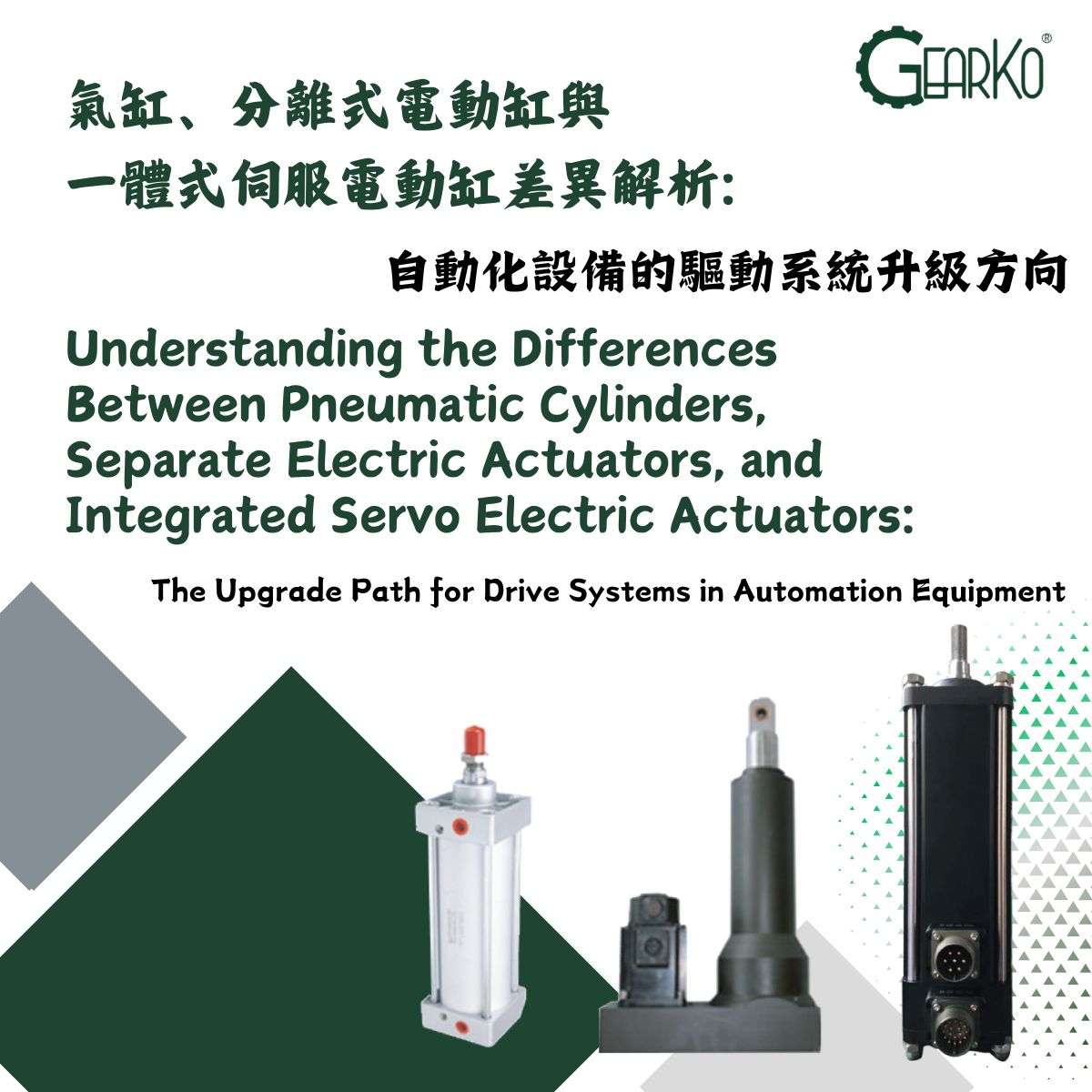
In the design and upgrading of automation equipment, the choice of drive system directly affects equipment accuracy, stability, and overall maintenance cost. Traditionally, most machines have relied on pneumatic systems. As process requirements continue to rise, electric actuators have gradually been introduced into a wider range of applications. However, in practice, electric actuators themselves come in different architectures, with significant differences in performance and system integration complexity.
Therefore, rather than simply comparing “pneumatic cylinders and electric actuators,” a more practical approach is to evaluate them from a system architecture perspective. The three most common solutions include:
- Pneumatic Cylinder
- Separate Electric Actuator (Motor + Driver + Actuator)
- Integrated Servo Electric Actuator
1. Pneumatic Cylinders: Suitable for Cost-Sensitive and Simple Motion Applications
The main advantages of pneumatic systems are their simple structure, low initial cost, and ability to achieve rapid reciprocating motion. For this reason, they are still widely used in basic operations such as handling, clamping, and positioning.
However, their limitations are also quite clear:
- Thrust and speed control depend mainly on air pressure, making precise adjustment difficult
- Repeat positioning accuracy is limited and highly affected by environmental and load variations
- Continuous air supply is required during long operating cycles, resulting in relatively low energy efficiency
- Piping and valve systems increase the risk of air leakage and maintenance issues
As a result, in applications where higher precision and system stability are required, pneumatic cylinders are gradually being replaced by electric solutions.
2. Separate Electric Actuators: A Transitional Solution in Electrification
Separate electric actuators use servo motors and drivers combined with ball screw or belt-driven mechanisms to improve position control capability and repeatability.
Compared with pneumatic cylinders, their advantages include:
- Position, speed, and thrust can be controlled
- Accuracy and repeatability are significantly improved
- No compressed air supply is required
However, from a system integration perspective, several challenges remain:
- The motor, driver, and actuator body are separated, making integration more complex
- More installation space and wiring are required
- Control parameters often need to be adjusted individually, increasing setup time
- Higher system inertia can affect dynamic response
Therefore, while separate electric architectures improve upon the limitations of pneumatic systems, they still face constraints when higher levels of integration and modular equipment design are required.
3. Integrated Servo Electric Actuators: System Advantages Brought by Integrated Design
Integrated servo electric actuators combine the servo motor, drive control, and mechanical structure into a single module. The purpose of this design is to reduce external connections and adjustment requirements while improving overall system consistency.
Their key features include:
- High-precision position control and stable thrust output
- A compact structure that reduces machine size and installation complexity
- Pre-integrated control parameters that shorten commissioning time
- Reduced wiring and communication integration difficulty
- Fewer maintenance points and lower risk of failure
From an engineering perspective, integrated design is not merely about combining components. More importantly, it simplifies the overall system architecture, enabling greater stability during both the design stage and actual operation.
4. Comparison of the Three Drive Systems
|
Item |
Pneumatic Cylinder |
Separate Electric Actuator |
Integrated Servo Electric Actuator |
|
Control Method |
Pneumatic Control |
Servo Control |
Servo Control (Integrated) |
|
Positioning Accuracy |
Low |
Medium to High |
High |
|
Repeatability |
Low |
High |
High |
|
System Integration |
Simple (Limited Functionality) |
Complex |
Simplified |
|
Installation & Wiring |
Air Piping Required |
Complex Wiring |
Simplified |
|
Energy Efficiency |
Low |
High |
High |
|
Maintenance Requirement |
High |
Medium |
Low |
|
Typical Applications |
Basic Movements |
Mid- to High-End Equipment |
High-Precision & Automated Equipment |
5. Selection Considerations: From “Motion” to “Control”
In modern automation equipment, selection criteria are no longer limited to whether a system can simply perform a motion. Instead, engineers increasingly need to consider:
- Whether the motion can be precisely controlled
- Whether the system operates in a stable and predictable manner
- Whether maintenance cost can be kept under control
- Whether the solution can be easily integrated into automation systems
Under these requirements, drive system selection is gradually shifting from pneumatic solutions to electric solutions, and further toward more integrated system designs.
Conclusion
Overall, pneumatic cylinders, separate electric actuators, and integrated servo electric actuators each correspond to different stages of equipment requirements and technological development.
For basic motion tasks and cost-driven applications, pneumatic systems still offer certain advantages. However, when equipment begins to demand higher control capability and greater stability, electrification becomes an inevitable trend. Furthermore, as automation and smart manufacturing continue to evolve, the level of system integration is becoming a key factor affecting both equipment performance and long-term operating cost.
Therefore, when selecting a drive solution, it is no longer sufficient to compare the performance of individual components alone. A more effective approach is to evaluate the overall system architecture in terms of long-term stability, integration efficiency, and actual application requirements.
If your equipment is facing an upgrade, or if you are evaluating the differences among various drive solutions, it is recommended to assess them based on actual operating conditions such as load, required precision, cycle time, and space limitations.
GearKo provides a range of servo drive solutions and application-based selection support. Feel free to contact us for technical evaluation and configuration recommendations tailored to your actual application needs.