2026.02.25
Why Are More Machines Switching to Electric Cylinders? A Complete Comparison of Electric, Pneumatic, and Hydraulic Cylinders
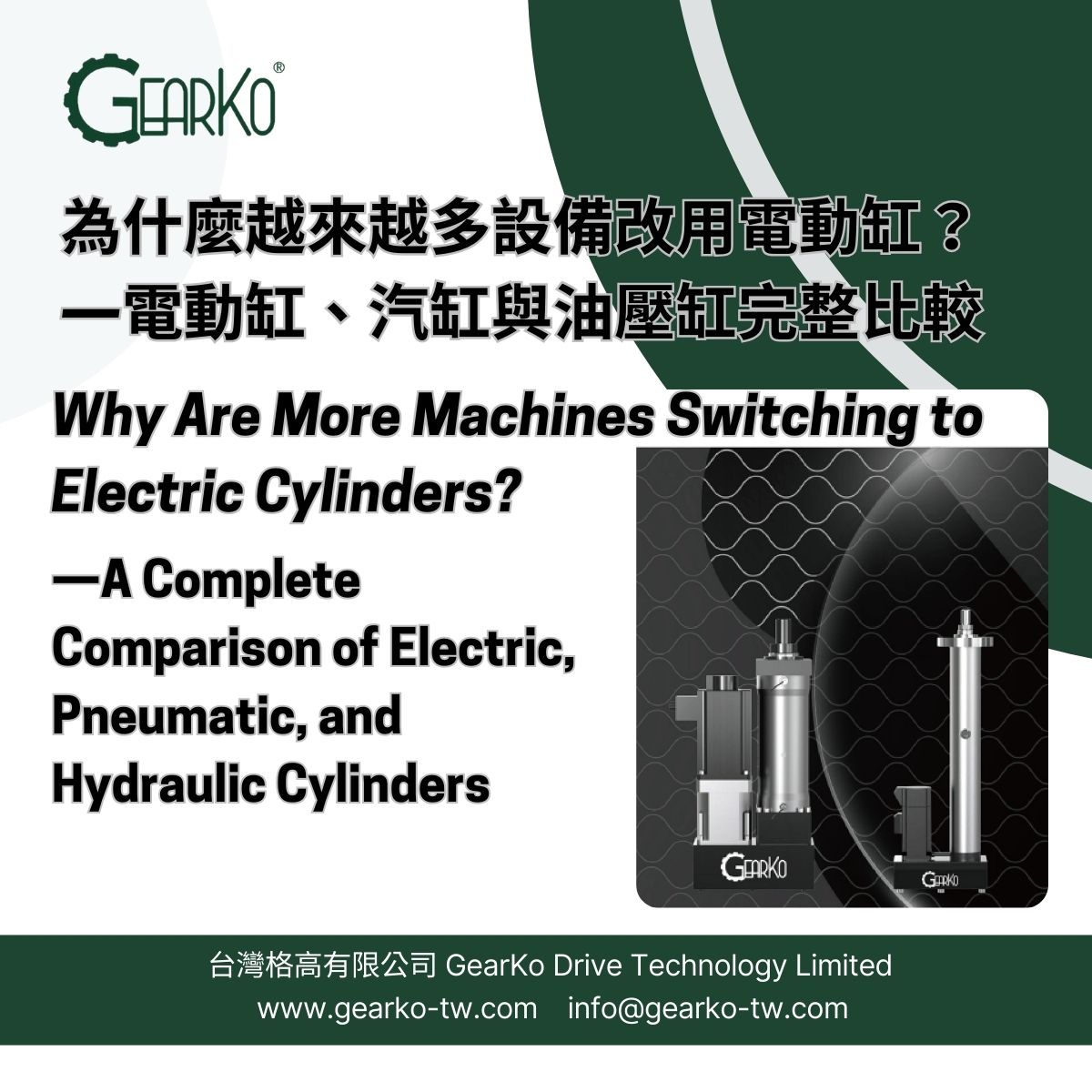
As automation and smart manufacturing continue to evolve, the demand for precise linear motion control is increasing rapidly.
Traditional solutions typically include pneumatic cylinders and hydraulic cylinders. However, in recent years, electric cylinders have gradually become the preferred choice for high-end equipment.
So what are the differences between electric cylinders, pneumatic cylinders, and hydraulic cylinders?
Why are more machines switching to electric cylinders?
This article provides a comprehensive analysis from the perspectives of principle, performance, maintenance, and application.
1. What Is an Electric Cylinder?
A Comparison of Three Actuation Principles
1. Pneumatic Cylinder
A pneumatic cylinder uses compressed air to drive a piston for linear motion. It features a simple structure, low initial cost, and fast response.
Advantages:
- Simple structure
- Low initial cost
- Suitable for rapid reciprocating motion
Limitations:
- Limited positioning accuracy
- Thrust depends on air pressure stability
- Lower energy efficiency (continuous air supply required)
Typical applications: Clamping devices, simple transfer mechanisms.
2. Hydraulic Cylinder
A hydraulic cylinder generates high thrust through hydraulic oil pressure and is commonly used in heavy-duty machinery.
Advantages:
- High thrust capability
- Suitable for high-load applications
Limitations:
- Complex system structure
- Risk of oil leakage
- Higher maintenance cost
- Not suitable for clean environments
Typical applications: Pressing equipment, heavy machinery.
3. Electric Cylinder
An electric cylinder converts rotary motion into linear motion by using a servo motor to drive a ball screw or planetary roller screw.
Core advantages:
- High-precision positioning control
- Programmable speed and thrust
- Easy integration with PLC and servo systems
- Clean operation (no oil contamination)
- Low maintenance requirements
Typical applications: Automation equipment, semiconductor machinery, inspection systems, smart production lines.
2. Electric vs. Pneumatic vs. Hydraulic Cylinders – Key Comparison
|
Comparison Item |
Pneumatic Cylinder |
Hydraulic Cylinder |
Electric Cylinder |
|
Positioning Accuracy |
Low |
Medium |
High |
|
Thrust Control |
Difficult |
Controllable |
Precise & Programmable |
|
Energy Efficiency |
Low |
Medium |
High |
|
Maintenance Cost |
Medium |
High |
Low |
|
Cleanliness |
High |
Low |
High |
|
Smart Integration |
Difficult |
Difficult |
Easy |
From the table above, it is clear that when equipment requires precise positioning, repeatable control, and smart integration, electric cylinders offer significant advantages.
3. Why Are Electric Cylinders Becoming the Trend in Smart Manufacturing?
1. Precision Motion Control
Electric cylinders provide high positioning accuracy and stable thrust control, making them ideal for industries with strict dimensional and consistency requirements.
2. Energy Saving and Environmental Benefits
No need for compressed air systems or hydraulic circuits, reducing energy waste and environmental risks.
3. Lower Long-Term Maintenance Costs
Without hydraulic oil or pneumatic systems, maintenance becomes simpler and more predictable.
4. Industry 4.0 Compatibility
Electric cylinders can be directly integrated into automation control systems, enabling data monitoring and smart upgrades.
4. GearKo Electric Cylinder Solutions
To meet high-precision and high-reliability requirements, GearKo provides integrated electric cylinder solutions featuring:
- High-rigidity structural design
- Precision screw transmission
- Integration with planetary gearboxes
- Customizable stroke and thrust specifications
Suitable for automation equipment, testing systems, and production line upgrades.
Frequently Asked Questions (FAQ)
Q1: Can electric cylinders replace hydraulic cylinders?
For extremely high-load applications (such as large-scale stamping), hydraulic cylinders still offer advantages.
However, in most automation and precision equipment, electric cylinders can effectively replace hydraulic systems.
Q2: Are electric cylinders more expensive?
The initial cost may be higher. However, considering lower energy consumption and reduced maintenance, the total cost of ownership (TCO) is often more competitive in the long term.
Conclusion: When Should You Choose an Electric Cylinder?
You should consider an electric cylinder when your application requires:
✔ High positioning accuracy
✔ Programmable motion control
✔ Reduced maintenance costs
✔ Smart manufacturing integration
In such cases, electric cylinders provide greater long-term value.