2026.10.07
Insufficient Servo Motor Torque? Diagnose the Cause Before Adding a Gearbox or Replacing the Motor
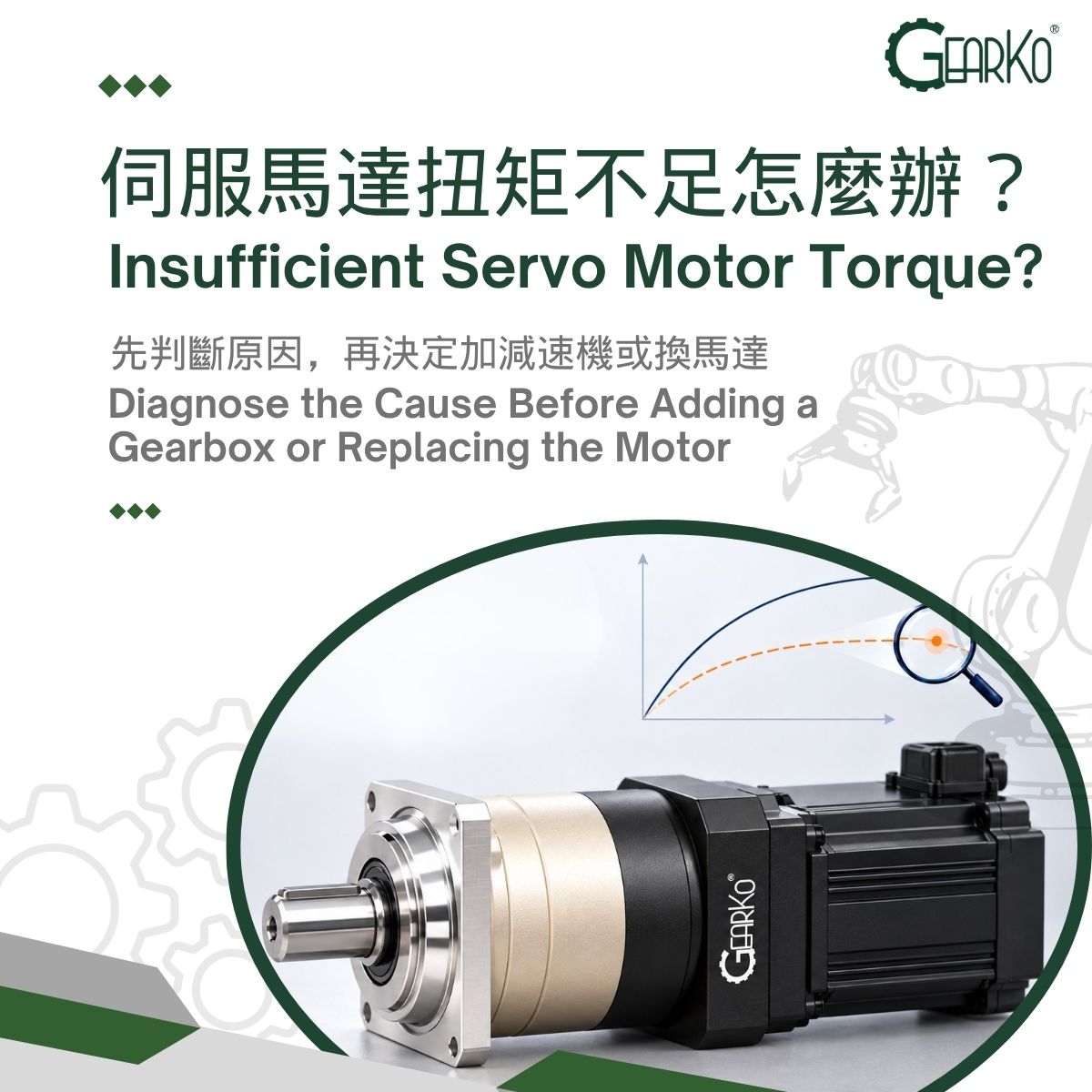
Insufficient servo motor torque does not always call for a bigger motor. It usually shows up in one of three ways: the motor lacks torque during continuous operation, it lacks torque only when accelerating or starting, or it has enough torque but vibrates and positions poorly because of an inertia mismatch. Each case has a different fix. Identify which one you are facing first, then decide whether to add a gearbox, change the gear ratio, adjust the acceleration time or replace the motor.
This article explains how to diagnose the cause and when each solution applies.
Step 1: Which Kind of Torque Is Insufficient?
Servo motor sizing normally requires two torque checks: the application's effective (RMS) torque must not exceed the motor's rated torque, and the maximum torque required during the motion must not exceed the motor's maximum instantaneous torque. In addition, the ratio of load inertia to motor rotor inertia (the inertia ratio) must stay within the range recommended by the motor manufacturer.
Use the table below to match what you see on the machine to the likely cause:
| Symptom | Likely cause | Values to check | First solution to consider |
|---|---|---|---|
| Cannot run at constant speed; motor overheats or trips an overload alarm | Continuous load torque exceeds the motor's rated torque | Load torque, effective (RMS) torque | Add a gearbox or increase the ratio; replace the motor only if still insufficient |
| Fine at constant speed, but alarms during acceleration, start-up or emergency stops | Acceleration torque exceeds the maximum instantaneous torque | Load inertia, acceleration/deceleration time, peak torque | Lengthen acceleration time, add a gearbox |
| Torque is sufficient, but the axis vibrates, settles slowly or cannot be tuned to higher gain | Load inertia too high; inertia ratio outside the recommended range | Load inertia, rotor inertia, inertia ratio | Add a gearbox to improve inertia matching |
Pay particular attention to the third case: enough torque does not mean a stable system. The problem is inertia matching, not torque. A larger motor would also lower the inertia ratio, because its rotor inertia is higher, but size and cost usually rise with it. Adding a gearbox is often the more efficient fix, as explained below.
Solution 1: Add a Gearbox
A gearbox addresses both insufficient torque and inertia mismatch at once. This is the key difference from simply installing a bigger motor.
1. It multiplies output torque
A gearbox reduces speed and increases torque according to its ratio:
T₂ = T₁ × i × η
n₂ = n₁ ÷ i
- T₂: gearbox output torque (Nm)
- T₁: motor torque (Nm)
- i: gear ratio
- η: gearbox efficiency (as a decimal, from the catalog)
- n₁, n₂: motor speed and gearbox output speed (rpm)
2. It reduces the load inertia seen by the motor
Load inertia reflected to the motor shaft is divided by the square of the gear ratio. The inertia ratio is calculated as:
Inertia ratio = JL ÷ (JM × i²)
- JL: load inertia (kg·m²)
- JM: motor rotor inertia (kg·m²)
For example, if the load inertia is 100 times the rotor inertia, a direct-coupled system has an inertia ratio of 100. With a 5:1 gearbox, the ratio drops to 100 ÷ 25 = 4; with 10:1, it drops to 1. Torque is multiplied by i, while reflected inertia is divided by i². That is why a gearbox is so effective at improving inertia matching.
The trade-off
A gearbox reduces output speed to 1/i. Before adding one, confirm that the required machine speed multiplied by the ratio does not exceed the motor's maximum speed or the gearbox's permissible input speed.
Solution 2: Change the Gear Ratio
If a gearbox is already installed and torque is still insufficient, consider a higher ratio. A higher ratio is not always better, though. Both extremes cause problems:
| Ratio | What goes wrong |
|---|---|
| Too low | Not enough torque multiplication; high inertia ratio causes vibration during positioning |
| Too high | Output speed too low, so the motor must run near its maximum speed to reach machine speed; may exceed the gearbox's permissible input speed |
A practical approach is to work backward from the required output speed and output torque:
- Divide the motor's rated speed by the required output speed to find the maximum ratio.
- Divide the required torque by (motor rated torque × efficiency) to find the minimum ratio.
- Between these limits, choose a standard ratio that keeps the inertia ratio within the motor manufacturer's recommended range.
If the minimum ratio is higher than the maximum ratio, no ratio can satisfy both speed and torque, and a different motor is needed (see Solution 3).
Solution 3: Use a Larger Motor
A gearbox multiplies torque but cannot add power. It trades speed for torque, so after transmission losses, output power is equal to or slightly below the motor's power.
When the application needs high speed and high torque at the same time, and the required power exceeds what the motor can deliver, neither a gearbox nor a new ratio will solve it. Only then is a more powerful motor needed. Typical signs:
- Working backward as in Solution 2, the minimum ratio exceeds the maximum ratio
- Required power (torque × angular velocity) exceeds the motor's rated output
- Effective (RMS) torque still exceeds the motor's rated torque after increasing the ratio, and speed cannot be reduced further
When changing motors, recheck the gearbox's rated torque, permissible input speed and input flange.
Solution 4: Adjust Acceleration and Deceleration Time
If torque is insufficient only during acceleration, start-up or emergency stops, start by checking the acceleration time. It costs nothing. Acceleration torque is proportional to angular acceleration:
Ta = J × α
α = Δω ÷ t
- Ta: acceleration torque (Nm)
- J: total inertia reflected to the motor shaft (kg·m²)
- α: angular acceleration (rad/s²)
- Δω: change in angular velocity (rad/s); convert speed n (rpm) with ω = 2π × n ÷ 60
- t: acceleration time (s)
With the same inertia and target speed, doubling the acceleration time halves the acceleration torque.
No parts need to change, but each motion cycle gets longer. If the machine's cycle time has no margin, go back to Solution 1 and use a gearbox to reduce the inertia seen by the motor.
Specifications to Check When Choosing a Servo Gearbox
Once you decide to add a gearbox, check these specifications against the motor and the application:
| Specification | What to check |
|---|---|
| Rated output torque | At least the application's continuous (effective) torque |
| Permissible peak torque, emergency stop torque | At least the momentary torque during acceleration, deceleration and emergency stops |
| Gear ratio | Meets output speed, output torque and inertia ratio requirements together |
| Permissible input speed | At least the motor's actual maximum operating speed |
| Backlash (arcmin) | Meets the machine's positioning accuracy |
| Efficiency | Use the catalog value when calculating output torque |
| Input flange and shaft diameter | Match the servo motor's mounting dimensions |
| Permissible radial and axial load | At least the external forces on the output shaft |
Manufacturers define rated torque, peak torque and service factors differently. Always confirm final selection against the catalog for the specific series.
FAQ
Does a servo motor always need a gearbox?
No. If the load inertia is low, the required torque is within the motor's rating and the required speed is close to the motor's speed, direct coupling works. A gearbox is needed when torque is insufficient, the inertia ratio is too high or the required speed is far below the motor's speed.
Does adding a gearbox increase motor power?
No. A gearbox trades speed for torque. Output power equals motor power minus transmission losses.
What inertia ratio should I aim for?
The recommended value varies by motor brand and series, so follow the motor manufacturer's manual. The calculation is: load inertia ÷ (rotor inertia × gear ratio²).
What is the difference between rated torque and peak torque?
Rated torque is what the motor or gearbox can deliver continuously under the manufacturer's specified conditions. Peak torque is a higher value allowed only for short periods, such as acceleration. Check both against the application.
Is a higher gear ratio always better?
No. Too high a ratio leaves the output speed too low and may push the motor beyond its permissible speed. Work backward from the required speed and torque to find the right range.
Need Help Diagnosing Insufficient Servo Motor Torque?
Send us the following details and GearKo can help determine whether a gearbox is needed, and which ratio and model fit:
- Servo motor brand and model (or rated torque, rated speed and rotor inertia)
- Load weight and mechanism (conveyor, rotary table, ball screw, robot arm, etc.)
- Required output speed and acceleration/deceleration time
- Positioning accuracy requirement
- Current symptoms or alarm codes
To shorten the drive train and save space, see the GHAM Series integrated servo motor gearbox, which combines a servo motor with a precision planetary gearbox, or browse GearKo planetary gearboxes.