2026.08.13
Gear Reducers for Humanoid Robot Joints: How to Choose Between Harmonic and Planetary Gear Reducers
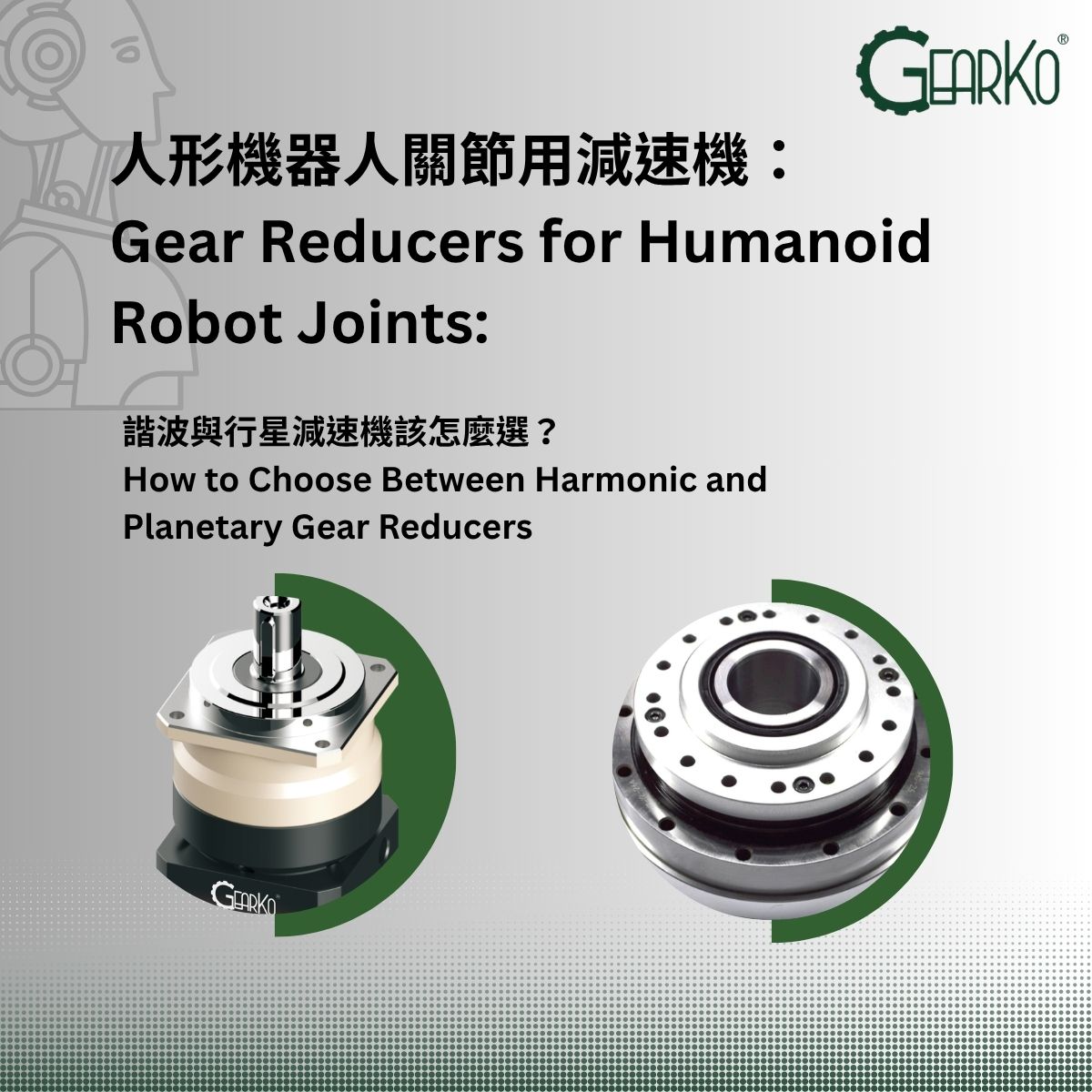
As humanoid robots move closer to commercial deployment, demand for precision transmission components in joint actuators continues to grow.
Harmonic gear reducers offer high reduction ratios, low backlash, and compact construction, while precision planetary gear reducers are known for their high efficiency, torsional rigidity, and load capacity.
However, each joint in a humanoid robot has its own load and motion requirements. No single transmission solution is suitable for every joint. Proper selection requires a comprehensive evaluation of output torque, reduction ratio, positioning accuracy, installation space, shock loads, energy efficiency, and backdrivability.
This article compares the characteristics of harmonic and precision planetary gear reducers and outlines the key considerations when selecting transmission solutions for humanoid robot joints.
Core Gear Reducer Requirements for Humanoid Robots
The mechanical design of a humanoid robot must balance torque, accuracy, rigidity, efficiency, and reliability within strict space and weight limitations.
Compared with stationary industrial robot arms, humanoid robots must not only perform precise operations but also withstand ground reaction forces and the dynamic loads generated by frequent starts, stops, and changes in direction while walking. For battery-powered robots, transmission efficiency also directly affects overall operating time.
Common joint transmission requirements include:
- High torque density
- Low backlash and good positioning accuracy
- Compact and lightweight construction
- Sufficient torsional rigidity
- High transmission efficiency
- The ability to withstand peak torque and shock loads
- Backdrivability suited to the control strategy
- Consistent service life and reliability
Design priorities vary from one joint to another. For example, wrists and neck joints generally place greater emphasis on size, weight, and positioning accuracy. Hip, knee, and ankle joints require particular attention to peak torque, shock loads, rigidity, and energy efficiency.
Gear reducer selection should therefore be based on actual load conditions, motion requirements, and the overall actuator architecture rather than on joint location alone.
How Does a Harmonic Gear Reducer Work?
A harmonic gear reducer mainly consists of a wave generator, a flexspline, and a circular spline.
The wave generator elastically deforms the flexspline, causing multiple teeth of the flexspline and circular spline to engage simultaneously. The difference in the number of teeth between these two components produces the speed reduction. This structure enables a high reduction ratio in a single stage while maintaining low backlash and a compact form factor.
Key Advantages of Harmonic Gear Reducers
- High single-stage reduction ratio: A high reduction ratio can be achieved within limited installation space without requiring multiple gear stages.
- Low backlash: Simultaneous engagement of multiple teeth reduces mechanical play during changes in direction, making the reducer suitable for joints requiring high positioning and repeatability performance.
- Compact construction: Even at high reduction ratios, the axial length and overall weight can remain relatively low.
- Hollow-shaft options: Certain configurations provide a hollow bore through which cables, signal wires, or tubing can pass through the center of the joint.
- Smooth operation: Multi-tooth engagement helps provide stable and smooth motion transmission.
Harmonic Gear Reducer Selection Considerations
- Because the flexspline undergoes elastic deformation, torsional rigidity and angular deflection under changing loads must be evaluated.
- Service life is affected by the load spectrum, peak torque, operating speed, and lubrication conditions.
- For applications involving frequent shocks or highly dynamic loads, momentary allowable torque and fatigue life must be carefully verified.
- Transmission efficiency can be affected by the reduction ratio, load factor, operating speed, and lubrication conditions.
- Harmonic gear reducers require high manufacturing precision and are generally more expensive.
Harmonic gear reducers are commonly suitable for rotary joints requiring low backlash, a high reduction ratio, and compact dimensions, such as shoulder, wrist, neck, and certain waist joints. The final configuration, however, should be determined according to the actual load conditions and overall actuator design.
How Does a Precision Planetary Gear Reducer Work?
A planetary gear reducer primarily consists of a sun gear, planet gears, a planet carrier, and an internal ring gear.
During operation, multiple planet gears simultaneously mesh with the sun gear and the internal ring gear, distributing the load across multiple contact points. This arrangement helps improve load capacity, torsional rigidity, and transmission efficiency.
Key Advantages of Precision Planetary Gear Reducers
- High transmission efficiency: Suitable for applications where energy efficiency and battery operating time are important.
- High torsional rigidity: Reduces angular deflection under changing loads and improves control responsiveness.
- Good load capacity: Multiple planet gears share the load, making the reducer suitable for higher-torque applications.
- Adaptability to dynamic loads: Generally well suited to frequent starts, stops, directional changes, and shock loads.
- Wide range of configurations: Products can be selected according to size, reduction ratio, accuracy, output configuration, and mounting method.
- Mature supply chain: Well-established manufacturing technologies and a broad selection of specifications make integration with different motors and mechanical designs easier.
Precision Planetary Gear Reducer Selection Considerations
- Higher reduction ratios generally require multiple stages, which may increase axial length, weight, and rotational inertia.
- Backlash varies according to gear accuracy, number of stages, and product grade. The appropriate level should be selected based on actual positioning requirements.
- High-resolution feedback systems and control algorithms can compensate for some positioning errors, but they cannot replace the low backlash, rigidity, and transmission accuracy of the gear reducer itself.
- If joint space is extremely limited, the outer diameter, axial length, and motor integration method must be carefully evaluated.
Precision planetary gear reducers are suitable for joints that prioritize transmission efficiency, rigidity, load capacity, and dynamic-load performance. Miniature planetary reducers can also be used in compact transmission systems such as robotic fingers.
Comparison of Harmonic and Precision Planetary Gear Reducers
|
Comparison |
Harmonic Gear Reducer |
Precision Planetary Gear Reducer |
|
Reduction ratio |
High reduction ratios can be achieved in a single stage |
High reduction ratios generally require multiple stages |
|
Backlash |
Extremely low and suitable for high-precision positioning |
Depends on the accuracy grade; precision models can achieve less than 1 arcmin |
|
Dimensions |
Maintains a compact structure even at high reduction ratios |
Multi-stage designs may increase axial length |
|
Transmission efficiency |
More sensitive to reduction ratio, load factor, and lubrication conditions |
Generally higher |
|
Torsional rigidity |
Elastic deformation of the flexspline must be considered |
Generally higher |
|
Load capacity |
Must be evaluated according to the flexspline, bearing arrangement, and overall product structure |
Multiple planet gears share the load, generally providing higher load capacity |
|
Shock-load capability |
Peak torque capacity and flexspline fatigue life must be verified |
Generally better suited to highly dynamic and shock-load applications |
|
Backdrivability |
Depends on reduction ratio, friction, and overall design |
Can be improved by using a lower reduction ratio |
|
Cost |
Generally higher |
Mature supply chain with a wider range of product options |
|
Typical requirements |
Low backlash, high reduction ratio, and limited installation space |
High efficiency, high rigidity, and high load capacity |
Actual performance varies according to the product model, size, reduction ratio, load factor, and lubrication method. Selection should always be based on the technical specifications of the individual model.
What Transmission Solutions Are Commonly Used for Different Joints?
Humanoid robot joint architectures continue to evolve rapidly. In addition to harmonic and precision planetary gear reducers, designs may incorporate cycloidal reducers, quasi-direct-drive actuators, or linear actuators using ball screws or planetary roller screws.
The following table summarizes common design requirements and transmission options for different joints:
|
Joint/Application |
Primary Requirements |
Common Transmission Solutions |
|
Shoulder, wrist, and neck |
Compact size, low backlash, high reduction ratio |
Harmonic gear reducers and precision planetary gear reducers |
|
Elbow |
Compact construction, rigidity, torque control |
Harmonic, planetary, or screw-driven linear actuators |
|
Waist |
High torque, high rigidity, resistance to combined loads |
Harmonic, precision planetary, or cycloidal gear reducers |
|
Hip, knee, and ankle |
High peak torque, efficiency, shock-load capability, and backdrivability |
Precision planetary or cycloidal gear reducers, quasi-direct-drive actuators, or planetary roller screw linear actuators |
|
Fingers |
Miniaturization, low weight, and flexible configuration |
Miniature planetary reducers, miniature screw drives, or tendon/cable-driven systems |
The final configuration will also depend on the joint structure, motor dimensions, control strategy, and overall robot weight distribution. These solutions should therefore be considered general selection guidelines rather than fixed rules.
10 Key Parameters for Selecting a Humanoid Robot Gear Reducer
Before selecting a gear reducer for a robotic joint, the following conditions should be confirmed:
- Rated output torque: The continuous torque required during long-term joint operation.
- Peak acceleration and deceleration torque: The maximum torque generated during acceleration, deceleration, or directional changes.
- Momentary shock torque: The instantaneous load that may occur during landing, collision, or loss of balance.
- Output speed: The maximum and average operating speeds required by the joint.
- Reduction ratio: Calculated according to motor speed, joint speed, and required output torque.
- Backlash and transmission accuracy: These are separate performance indicators and should be evaluated independently.
- Torsional rigidity: Influences angular deflection and control response under changing loads.
- Installation space and weight: Includes outer diameter, axial length, hollow-bore dimensions, and total module weight.
- External loads: Radial load, axial load, and overturning moment must all be evaluated.
- Service life: Should be assessed according to the load spectrum, duty cycle, operating speed, and lubrication conditions.
The gear reducer is only one component of a joint actuator. The motor, bearings, encoder, structural rigidity, and controller all affect final performance. End-effector positioning accuracy therefore cannot be estimated from gear reducer backlash alone.
Harmonic and Planetary Gear Reducers Are Not Mutually Exclusive
Harmonic and precision planetary gear reducers each have their own suitable applications in humanoid robot design.
When low backlash, a high single-stage reduction ratio, and limited installation space are the main priorities, a harmonic gear reducer generally offers clear advantages. When a joint places greater emphasis on transmission efficiency, torsional rigidity, load capacity, and shock-load capability, a precision planetary gear reducer may be the better choice.
A single humanoid robot may use several transmission architectures to meet the requirements of different joints. The key to proper selection is finding the right balance among accuracy, torque, efficiency, size, weight, service life, and cost.
GearKo Precision Joint Transmission Solutions
GearKo offers HM Series harmonic gear reducers and a broad range of precision planetary gear reducers, including the GB and GD Series. These products can be selected according to the installation space, output torque, reduction ratio, accuracy, and rigidity requirements of different humanoid robot joints.
- GearKo HM Series Harmonic Gear Reducers: Backlash of ≤1 arcmin and single-stage reduction ratios from 30:1 to 160:1, making them suitable for rotary joints with limited installation space and demanding positioning requirements.
- GearKo Precision Planetary Gear Reducers, including the GB and GD Series: Available in a variety of sizes, reduction ratios, and accuracy grades, with backlash as low as ≤1 arcmin. They are suitable for robots and automation equipment requiring high transmission efficiency, rigidity, and load capacity.
Not sure which gear reducer is right for your application?
Provide us with your motor model, rated and peak torque, output speed, reduction ratio, accuracy requirements, and mounting dimensions. The GearKo Taiwan team will assist you in evaluating and selecting the appropriate solution.