2026.06.10
Planetary Gearbox Selection Support: Reducing Risks in Equipment Development
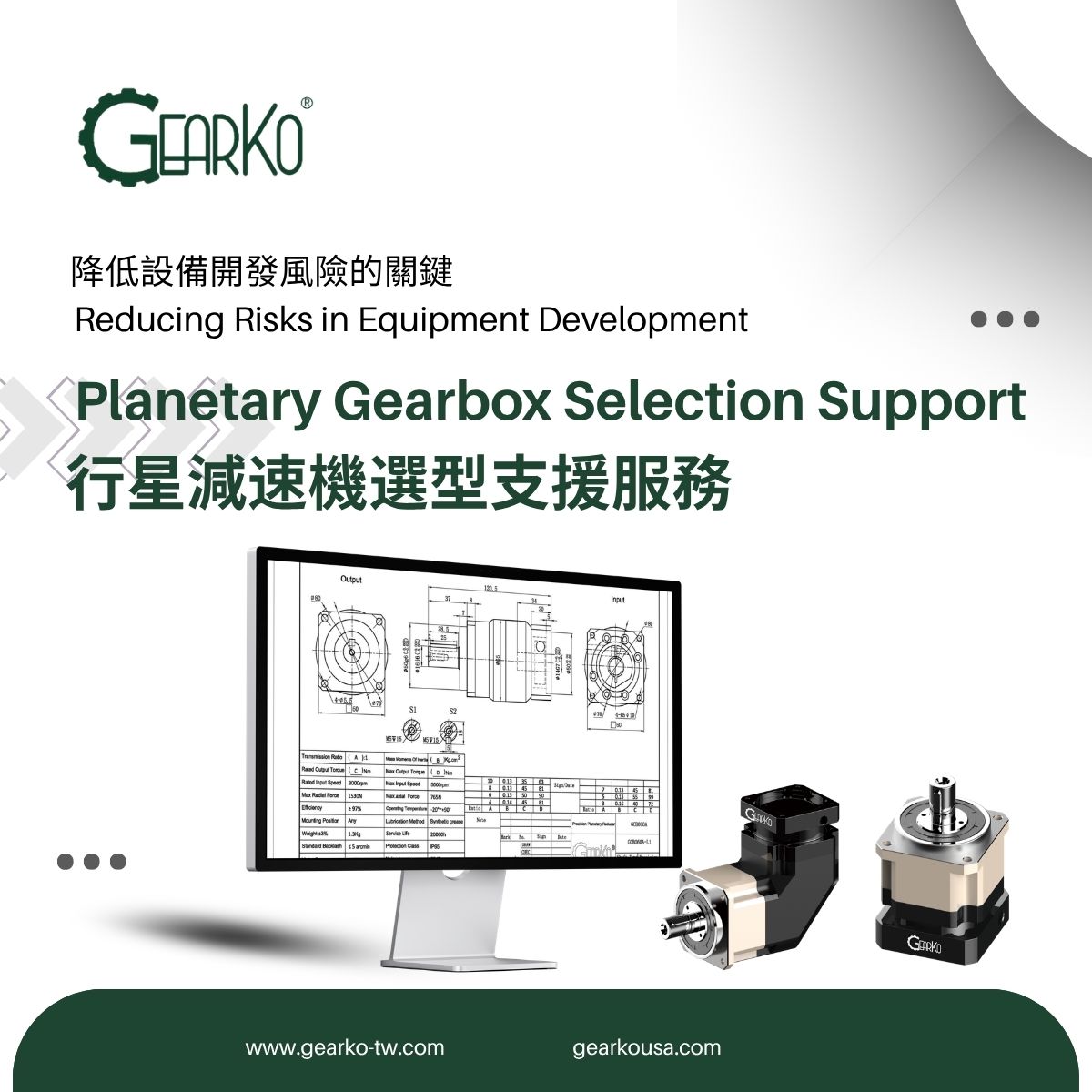
In industries such as industrial automation, robotics, laser cutting machines, machine tools, and smart manufacturing, planetary gearboxes have become essential components for delivering precise motion control and reliable power transmission. However, when planning a new project, many equipment manufacturers and machine designers focus primarily on reduction ratio, torque specifications, or product pricing, while overlooking another critical factor that can significantly influence project success—professional gearbox selection support.
In reality, issues such as unstable machine operation, insufficient positioning accuracy, installation incompatibility, or project delays are often not caused by gearbox quality itself. Instead, many of these problems originate during the selection stage. When gearbox specifications do not fully match the actual application requirements, even a high-quality gearbox may fail to deliver the expected performance.
For this reason, professional pre-sales technical support should not be viewed as an optional service. It is a crucial step in reducing development risks and improving project outcomes.
Planetary Gearbox Selection Involves More Than Choosing a Reduction Ratio
When discussing planetary gearbox selection, the first factor most people consider is the reduction ratio. However, successful gearbox selection requires much more than simply choosing a ratio from a catalog.
Engineers must also evaluate servo motor specifications, output torque requirements, operating speed, load inertia, positioning accuracy, installation space, and overall operating conditions. A miscalculation in any of these areas can affect the final performance of the equipment.
For example, an inappropriate reduction ratio may result in insufficient output speed or excessive motor loading. Selecting an unsuitable backlash level may compromise positioning accuracy, while an incompatible mounting interface can lead to costly design modifications and project delays.
Therefore, gearbox selection is not simply about choosing a product—it is about identifying the most suitable transmission solution for a specific application.
How GearKo Helps Customers Select the Right Planetary Gearbox
At GearKo, we believe the value of selection support extends far beyond providing product catalogs. Our goal is to help customers reduce development risks and improve overall equipment performance.
When we receive a project inquiry, we begin by understanding the application requirements, including servo motor brand and model, machine function, required output speed, load characteristics, and installation constraints. Through a comprehensive evaluation process, we can recommend the most suitable gearbox series, reduction ratio, and precision level for the application.
Once a product direction has been identified, we assist customers with motor compatibility verification and provide technical drawings for design validation. For projects involving special installation requirements, high-precision applications, or customized configurations, we can evaluate feasibility during the design stage, helping customers avoid unnecessary redesign costs later in the project.
Through a complete selection support process, customers can identify the right solution more efficiently while minimizing design errors and rework.
From Motor Matching to Drawing Verification: Reducing Design Uncertainty
For equipment manufacturers, a gearbox does not operate as an independent component. It is an integral part of the entire motion control system.
Different servo motor brands often feature unique flange dimensions, shaft specifications, and mounting interfaces. Verifying motor compatibility during the selection stage is therefore essential. Without proper evaluation, customers may need to manufacture adapter plates or redesign machine structures, resulting in additional costs and engineering time.
Technical drawing support is equally important. By providing detailed 2D and 3D drawings, engineers can verify installation dimensions, identify potential interference issues, and confirm equipment layouts before production begins.
Compared to discovering problems after machine assembly, completing technical validation early in the development process can significantly reduce costs and shorten project timelines.
Transparent Quotations and Reliable Lead Times Matter Too
Technical support is only one part of a successful project. Clear pricing information and realistic lead time planning are equally important.
Most equipment development projects follow strict schedules. Delays in receiving critical components can affect machine assembly, testing, and final delivery. Therefore, when selecting a gearbox supplier, factors such as communication efficiency and service responsiveness should be evaluated alongside product performance.
With transparent quotations, accurate specification confirmation, and reliable lead time planning, manufacturers can better manage project budgets and schedules while improving overall project efficiency.
Choosing More Than a Product—Choosing a Long-Term Technical Partner
As industrial automation continues to advance, equipment manufacturers demand higher levels of precision, efficiency, and reliability. As a result, gearbox suppliers are increasingly expected to serve as technical partners rather than simply product providers.
A reliable transmission system requires more than a high-quality planetary gearbox. It also depends on comprehensive technical support throughout the project lifecycle. From gearbox selection and motor matching to drawing verification and delivery planning, every step can influence final machine performance and project success.
For many manufacturers, the right supplier is not only a source of products but also a valuable engineering resource that helps solve challenges and reduce development risks.
GearKo has long supported automation equipment manufacturers worldwide through professional gearbox selection recommendations, motor compatibility verification, technical drawing support, and transparent project communication. Our goal is to help customers develop more reliable, efficient, and competitive motion control systems.
Related Articles
How to Calculate the Right Reduction Ratio for a Planetary Gearbox
Learn the relationship between reduction ratio, output speed, and torque to select the right specification for your application.
Planetary Gearbox Selection Guide: A Complete 14-Step Analysis
Understand the key factors involved in gearbox selection, including motor specifications, load conditions, and installation requirements.
Planetary Gearbox Selection Guide: Practical Calculation Examples
Explore real-world examples that demonstrate gearbox sizing methods and selection procedures, helping you better understand the decision-making process.
By combining professional technical support with a comprehensive understanding of gearbox selection principles, equipment manufacturers can accelerate development cycles and identify the most suitable transmission solution for their applications.